Business
Fresh reporting on October 15 sets out a conditional route for adventure tourism and hotels in designated national forest areas under Nepal’s new forest ordinance. The underlying measure was issued on October 13, not announced for the first time today. The President’s Office identifies it as the ordinance amending some Nepal laws relating to forests, 2083, issued on the Cabinet’s recommendation under Article 114 of the Constitution. Today’s development is detailed public reporting of its tourism provisions, rather than approval of a named construction project.
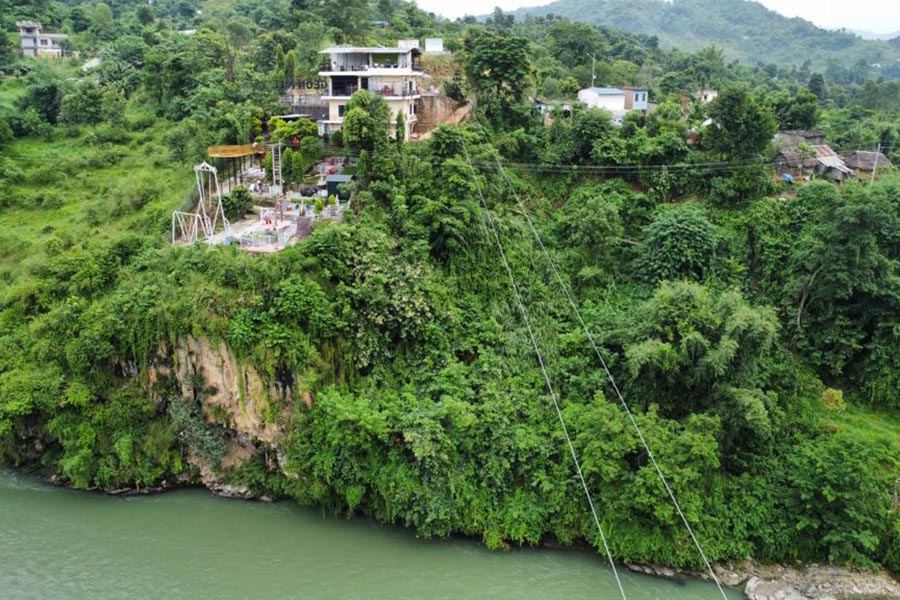
The official text inserts section 26A into the Forests Act, allowing the Council of Ministers to provide specified national forest areas on lease for nature based tourism without adverse environmental effects. Listed activities include paragliding, skydiving, bungee jumping, zip lining, rock climbing, rafting and canoeing. The section also covers cable cars, chairlifts, ropeways and gravity flow systems, as well as hotels with a rating of at least four stars. Other eligible infrastructure may be specified through a Nepal Gazette notice.
Construction is subject to a numerical ceiling: no more than 20 percent of the leased forest area or 2.5 hectares, whichever is smaller. The remaining land must be used for forest conservation, development and restoration. The text requires an environmental study under prevailing law, an environmental protection payment linked to the area used for infrastructure, and approval before trees are removed. It also provides for annual monitoring and withdrawal of the lease where legal, environmental study or agreement conditions are breached.
Onlinekhabar’s October 15 account places the change within the earlier leasehold forest framework, which already covered forest industry raw materials, plantation production, agroforestry and certain conservation compatible uses. Its report describes the amendment as a broader and more explicit tourism scope. It also states that the change does not open national parks or other ecologically sensitive forest areas to this infrastructure. The report should therefore not be reduced to a claim that tourism businesses can build anywhere inside Nepal’s forests.
The smaller of the two construction limits is important. As an illustrative calculation, a five hectare lease would have a one hectare ceiling from the 20 percent rule, while a twenty hectare lease would be capped at 2.5 hectares rather than four. These are examples of the stated area formula, not approved project designs. They do not establish how much usable land a particular proposal would receive after environmental review, site assessment and the conditions of its actual agreement.

UN Tourism provides a relevant framework for interpreting the conservation obligations. Its sustainable development guidance treats environmental, economic and social effects as connected, including impacts on host communities and cultural heritage. It calls for protection of ecological processes and biodiversity alongside viable operations and fairly shared local benefits. It also describes sustainability as a continuing process requiring monitoring and corrective action. This is international policy context, not a finding that any future project under Nepal’s ordinance already satisfies those objectives.
As analysis, the practical next milestones are designated areas, detailed implementation requirements and decisions on individual proposals. A listed activity is not a completed investment, and a construction ceiling is not a promise that every applicant receives the maximum area. The available reports do not announce a specific hotel opening, employment total or operating date. For Nepal’s tourism sector, the substantive change is a more explicit legal pathway accompanied by environmental conditions whose application will determine what is actually built and how it is managed.
Source publication date: 2026-10-15. Event or reporting period: 2026-10-13.
Sources:Onlinekhabar, Achyut Puri, October 15 at 1:49 pm NPT · President’s Office, ordinance issuance notice, October 13, 2026 · Government of Nepal, forest ordinance official text, section 26A, authenticated October 13 · UN Tourism, sustainable tourism policy framework
Source: GPT News Feed