Business
Tea exports through the Kakarbhitta customs point rose sharply during Asoj of the current fiscal year, according to customs figures reported by two Nepal news outlets on Tuesday, November 10. OnlineKhabar and Peoples’ Review both reported that 1,715,932 kilograms of tea valued at Rs495.45 million passed through the eastern border point during the month.
In the corresponding month of the previous fiscal year, the total was 902,445 kilograms worth Rs247.4 million. The dates need to be kept distinct: these are figures for Asoj, roughly mid-September to mid-October 2026, while the news reports were published on November 10. They do not describe tea shipped on a single day in November.
The comparison means export volume increased by just over 90 percent and declared value was approximately double the previous year’s level. Those percentages are arithmetic based on the customs totals, not separate forecasts or conclusions issued by the customs office.
A second calculation provides some useful context: the reported value works out to about Rs289 per kilogram this year, compared with roughly Rs274 per kilogram in the earlier period. That is an increase of about 5 percent in the average declared value per kilogram.
It suggests that most of the overall value growth came from the much larger volume, although the aggregate figures do not reveal individual grades, contracts, production costs or farm-gate prices.
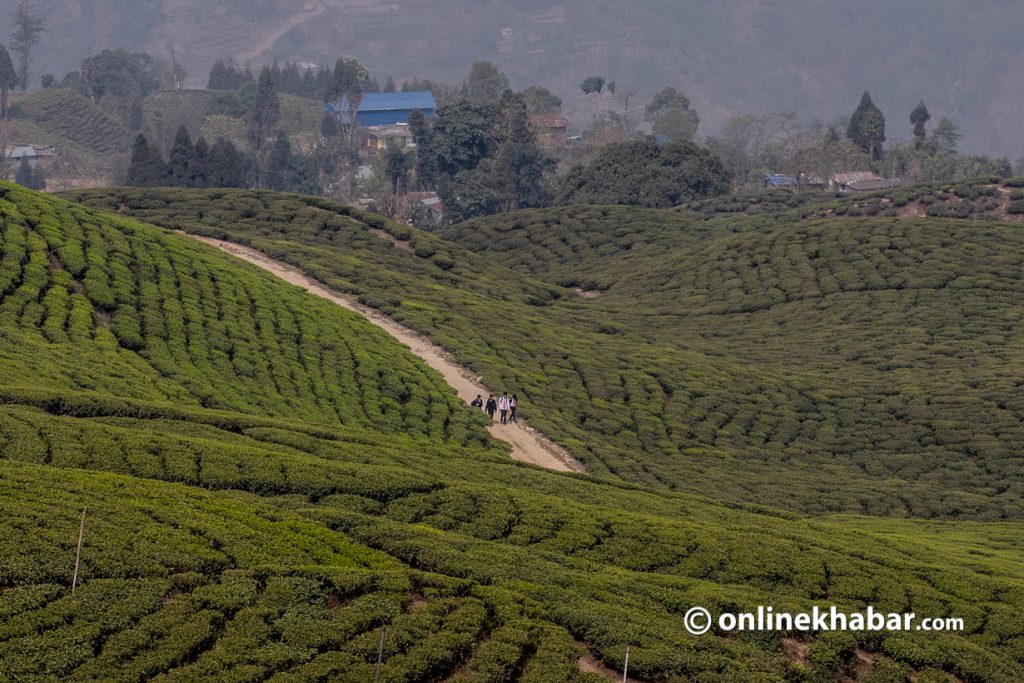
OnlineKhabar said the tea moving through Kakarbhitta is produced mainly in Ilam, Panchthar, Taplejung and Jhapa and is exported primarily to India. The numbers therefore have clear relevance for eastern Nepal’s farming, processing, transport and border-trade communities. However, this is one customs point and one monthly reporting period. It should not be presented as a complete national annual export total, proof that every producer received a higher price or evidence that the same pace will continue through the fiscal year.
The wider customs roundup shows that tea was part of a more varied export basket. Peoples’ Review, citing Mechi Customs information officer Mangal Rai, reported 541,940 kilograms of cardamom worth Rs988.88 million during Asoj. It also listed plywood worth about Rs442.34 million, iron sheets worth Rs298.47 million, broom grass worth Rs89.55 million, chhurpi worth Rs89.53 million and dried meat worth Rs48.32 million. These figures help place tea’s Rs495.45 million value in context without turning unlike products into a direct performance ranking. Each commodity has different prices, supply chains and measurement units.

There is also relevant policy background, but no verified basis for assigning it as the cause of the increase. In May, OnlineKhabar reported that the Tea Board of India had withdrawn mandatory sampling for Nepali tea intended for the Indian domestic market after a temporary disruption. Random sampling could still occur, while tea intended for re-export from India to third countries remained subject to mandatory quality testing.
That change is part of the trading environment faced by exporters. The available November reports do not establish that it produced the Asoj increase, so the two developments should be connected only as context rather than cause and effect.
As analysis, the most important next test is whether the higher volume persists across several months and whether export value continues to grow without weakening the average value received per kilogram. Longer-term gains would also depend on quality consistency, predictable border procedures and access to a broader range of buyers. None of those outcomes can be confirmed from one month’s data.
The present figures nevertheless provide a measurable positive signal for a major agricultural product from eastern Nepal: more than 1.7 million kilograms of tea moved through Kakarbhitta in Asoj, with reported value reaching nearly half a billion rupees.
For readers, the reliable takeaway is specific rather than sweeping. Kakarbhitta’s Asoj tea-export volume was a little more than 90 percent above the comparable month a year earlier, while value was about twice as high. Future coverage should look for cumulative fiscal-year totals, producer-level price information and confirmed market changes before describing a broader national trend. For now, the development is a timely eastern Nepal trade story grounded in a completed monthly comparison, not a prediction about the rest of the year.
Source publication date: 2026-11-10; OnlineKhabar published the tea export report on November 10 and Peoples’ Review published its customs roundup at 3:08 pm NPT. Event or reporting period: Asoj 2083, approximately mid-September to mid-October 2026; compared with Asoj 2082.
Sources:OnlineKhabar English, published November 10, 2026; tea export comparison, production districts, destination context and original featured photograph · Peoples’ Review, published November 10, 2026 at 3:08 pm NPT; Mechi Customs attribution and wider Asoj export figures · OnlineKhabar English, published May 20, 2026; earlier Tea Board of India sampling rule change and quality-testing context
Source: GPT News Feed