Business
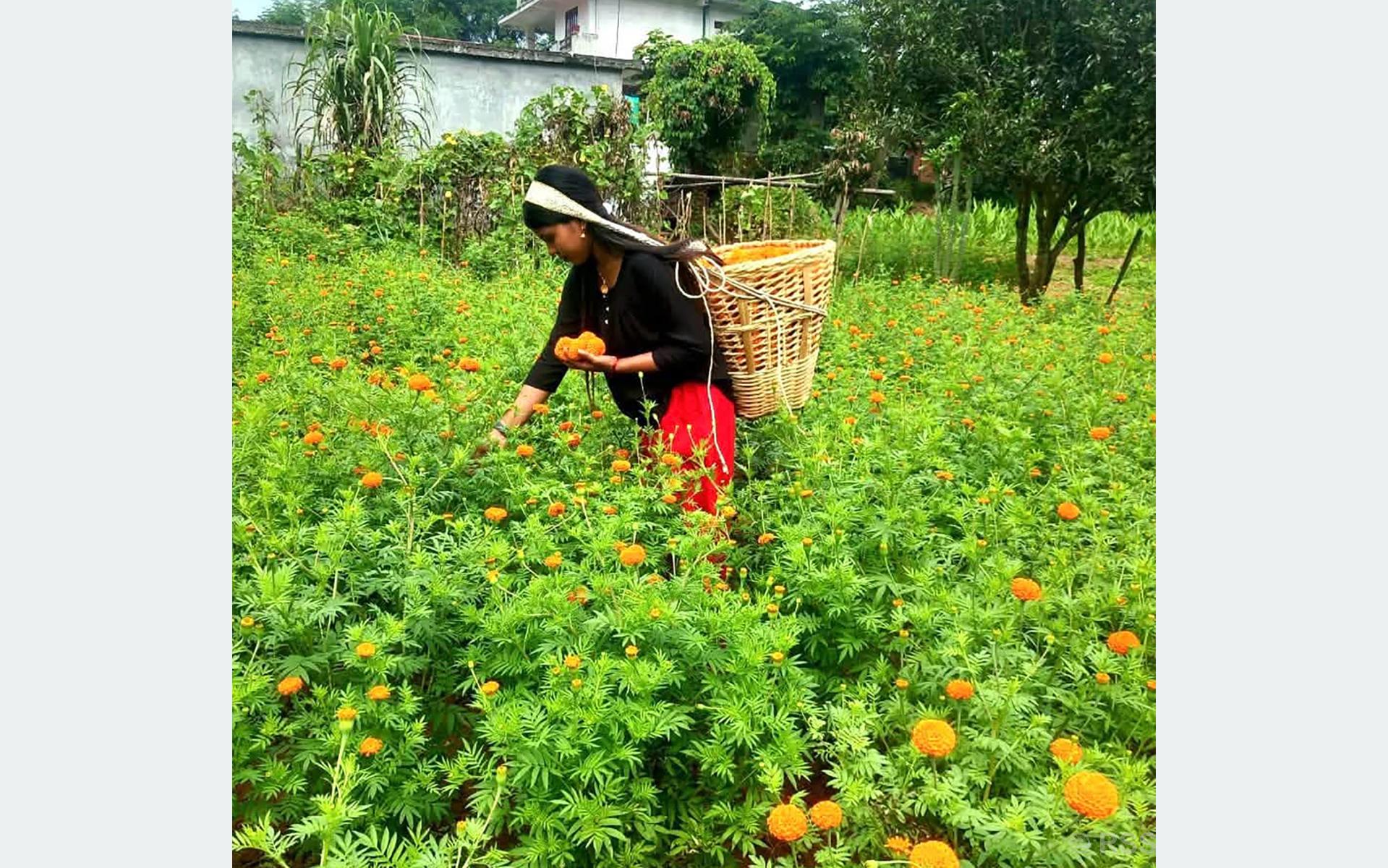
A women led marigold enterprise in Aandhimul Yanchowk of Aanbukhaireni Rural Municipality 1, Tanahun, has expanded to 45 ropanis as festival demand begins. Khabarhub reported on Monday, October 12 that 45 local women are participating in the commercial cultivation project. The fields are now being harvested ahead of Dashain, turning a three year old local initiative into a visible seasonal business. The matching figures of 45 ropanis and 45 participants describe the current scale, but they do not mean that every member manages exactly one ropani.
The first reported harvest received an order for 50 kilograms of flowers. Suntali Gurung, chairperson of the women’s group, said harvesting and sales began on Saturday after Kalpana Gauli, who operates a gift shop in Damauli, placed the order. Flowers are selling for as much as Rs 400 per kilogram, according to the report. The phrase as much as matters because it is a top quoted selling rate rather than evidence that every kilogram will receive that price or that the first order was completed entirely at the maximum.
The group model shares labour, experience and local resources among participants. Gurung said that bringing women together through collective enterprise made it easier to organize the work and create income opportunities. Commercial flower cultivation requires more than planting: members must coordinate inputs, manage timing, harvest blooms before quality declines, bundle or weigh the product and find buyers. A collective structure can spread those tasks across participants. Whether it produces strong individual profit will still depend on production costs, losses, transport and the price achieved for the full harvest.
Santosh KC, chief of the agriculture section at Aanbukhaireni Rural Municipality, said marigold farming had been underway in Aandhimul Yanchowk for three years and that locally produced flowers had a ready market. He identified more organized cultivation and marketing as routes for further development. His comments support the report’s account that this is an established project expanding over time, not a one day festival display. They also point to market access as the next business challenge after the group has demonstrated its ability to produce at a larger scale.
The timing is favourable because marigold flowers are widely used for garlands and decoration during Nepal’s major festivals. Demand can rise quickly, but festival markets are also brief and quality sensitive. Flowers harvested too early can lose freshness, while late harvests can miss peak buying. Local production shortens the distance to nearby buyers such as shops in Damauli and may reduce dependence on flowers brought from other places. That is a potential logistical advantage, not proof that the local crop has replaced all outside supply.

The initiative also has a community business dimension. Forty five women are gaining experience in production, group decision making and sales through their own labour. Khabarhub describes the project as supporting entrepreneurship and financial independence, while the reported evidence at this stage is the cultivated area, participation count, first order and listed price ceiling. Future reporting would need total production, costs, revenue and income distribution to measure the financial outcome. Those missing figures should not be invented from the size of the field alone.
The verified October 12 development is therefore a promising expansion with an active first market connection. The group has grown marigolds across 45 ropanis, begun harvesting, received a 50 kilogram order and involved 45 local women. Its next indicators will be repeat orders, the share of the crop sold, actual average price and access to buyers beyond the first Damauli shop. For now, the project offers a timely example of local festival supply and rural women building a collective commercial venture without requiring exaggerated claims about guaranteed profit or complete import replacement.
Source publication date: 2026-10-12. Event or reporting period: 2026-10-12.
Sources:Khabarhub
Source: GPT News Feed