Business
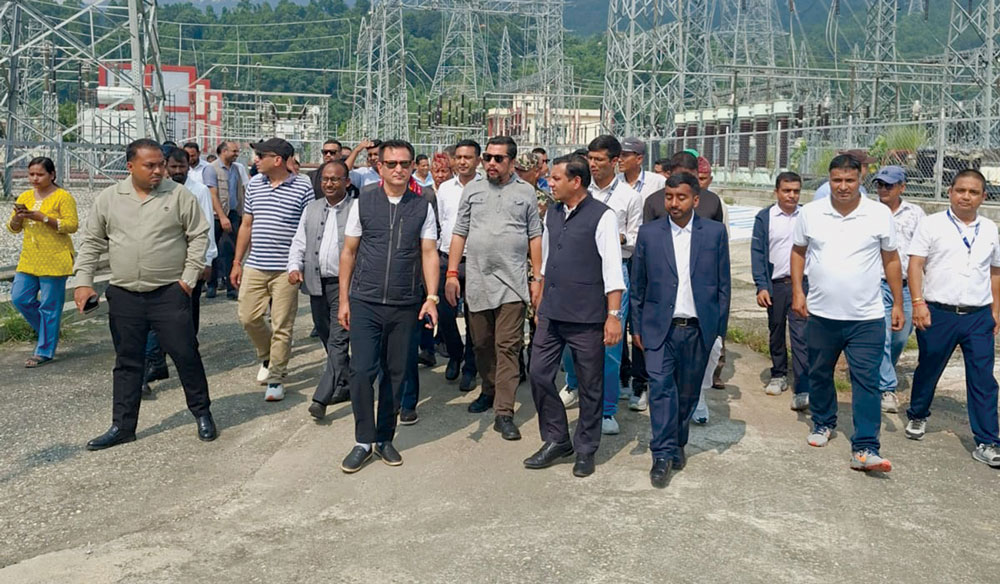
Nepal Electricity Authority is preparing to charge the Hetauda to Dhalkebar 400 kV transmission line after Dashain once two remaining multi circuit towers are completed. The Rising Nepal reported the latest progress on October 5, 2026, following an inspection by Energy, Water Resources and Irrigation Minister Biraj Bhakta Shrestha. The report describes a project approaching operation after a delay of roughly 12 years, but it does not provide a fixed commissioning day or confirm that electricity has already begun flowing through the new line.
NEA Managing Director Dirghayu Kumar Shrestha said 14 of the 16 towers required for the unfinished section have been completed. Construction on the last two towers is in its final stage, and the authority expects to finish them within 10 to 15 days before charging the line. Kantipur and Radio Nepal also reported the ministerial inspection and the plan to complete the outstanding structures. The time range is a construction target, so any exact operating date should wait for a later NEA confirmation.
The line is expected to start as a backup transmission route. Its wider role is to strengthen the east to west backbone of Nepal’s power system, allowing electricity generated in one part of the country to be moved more effectively to demand centres elsewhere. The minister said current transfer capacity from the Hetauda area toward Dhalkebar is about 300 megawatts. Once the 400 kV link is operational, the cited capacity could rise to around 2,000 megawatts.
That increase matters because generation and consumption are not always located in the same place or occurring at the same time. A stronger transmission corridor can give system operators more options when balancing supply, meeting industrial demand and responding to a fault on another route. It can also reduce the risk that electricity produced during the wet season cannot be delivered to users. These are expected system benefits reported by officials, not a guarantee that every consumer will experience an immediate change in tariff or service quality.
The project also has a regional trade dimension. A higher capacity east to west network can support movement of power toward interconnection points used for cross border trade while improving domestic reliability. The Nepal Electricity Authority’s earlier project reporting describes the broader Hetauda Dhalkebar Inaruwa corridor as a high capacity backbone with major substations at the three locations. The October update concerns the final obstacle on the Hetauda to Dhalkebar section, not the completion of every transmission investment planned across Nepal.

Officials linked the renewed construction process to a Cabinet decision that enabled stalled work to resume. Minister Shrestha said public funds had already been committed while the two towers remained unresolved for years. Completing them would convert previously stranded infrastructure into an operating asset. From a business perspective, that can improve the network serving factories and other large users, although the sources do not publish a project return estimate, a revised total cost or a forecast of additional electricity sales.
The verified development is therefore substantial but conditional. Fourteen towers are complete, work on the final two is progressing, and NEA is preparing to charge the line after Dashain. Commissioning still depends on finishing construction, conducting the necessary checks and receiving operational confirmation. Until that happens, the responsible description is that the transmission link has entered its final stage after a long delay, with potential benefits for grid reliability, industrial supply and electricity trade once the line is actually energised.
Source publication date: 2026-10-05. Event or reporting period: 2026-10-05.
Sources:The Rising Nepal · Kantipur · Radio Nepal
Source: GPT News Feed